
Multiple intelligence

What is the multiple intelligence theory?
The theory of multiple intelligences is originated by the psychologist Howard Gardner in 1983 and states that each person has different ways of learning and different intelligences they use in their daily lives.
Where some can learn very well in a linguistically-based environment (reading and writing), but others are better learned through mathematical-logic based learning.
While there’s so many people still benefit most from body-kinesthetic intelligence (learning by doing with the hands).
Which means that each person possesses each intelligence type to an extent, but there is always a primary, or more dominant, intelligence.
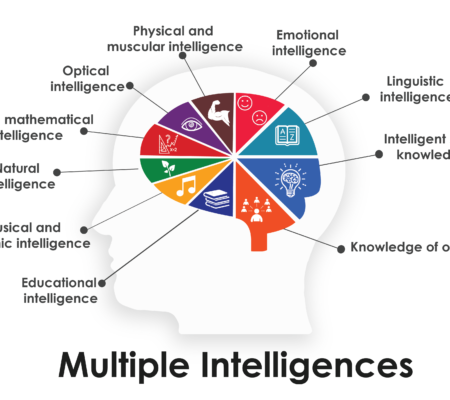
In 1990, Gardner noted additional capabilities as follow:
- Language communication and logical thinking (his first discoveries).
- Visual / spatial intelligence.
- Musical / tonal intelligence.
- Physical / muscular intelligence.
- Knowledge of self-knowledge / self-knowledge.
- Knowledge of others.
Later, Gardner admitted that there could be other intelligence, science should discover it, until 2016, Gardner added two intelligences to the theory:
- The intelligence of the natural world.
- Educational intelligence.
What are the characteristics of multiple intelligences?
Each person has a set of characteristics that refers to definite type on multiple intelligence skills like the follow:
It is the ability to use language and sensitivity to words and meanings of words and knowledge of grammar, and the ability to convey concepts in a clear way. The most intelligent people are poets, preachers and broadcasters.
It’s about a person’s mathematical and logical ability for abstract thinking and problem solving. The smartest people are mathematicians, engineers, physicists and researchers.
The person’s ability to form a precise and clear model of himself, and apply that model efficiently in real life at the basic level and knowledge of feelings of pleasure and pain.
These are the qualities of scholars, wise men and philosophers.
It is the power of observation of the differences between people, especially their natures, their intelligence and the knowledge of their intentions and desires.
These are the characteristics of the clergy and politicians who are rich in knowledge.

They are people who have the ability to deliver information in a clear manner.
Like teachers, instructors and coaches.
Means the person’s ability to control and flex the movements of his body and muscles.
These people are like swimmers, tumblers, and actors.

It defines the person’s ability to visualize, track trends and to estimate distances and sizes.
These people are like engineers, surgeons and painters.

It is the ability of a person to recognize sounds and rhythms.
They are people like singers, composers and performers.
Is the ability of a person to understand nature and its animals and plants and the ability to classify and differentiate between species diversity.
Like fishermen, hunters & environmental researchers.
The intelligence of existentialism
People who have the ability to think abstractly are the ones who think about life and death, or even beyond nature or after death.
Like biological scientists and mediation coaches.
Emotional intelligence is the ability of individuals to:
– Recognize their emotions and feelings towards other people.
– Differentiate and distinguish appropriately different emotions.
– Use emotional feelings to adapt thinking and behavior.
– Manage and adjust emotions to adapt to environments or achieve the individual’s objectives.
Although the term first appeared in a 1964 paper by Michael Beldock, it gained popularity in a 1995 book by the author and scientific journalist Daniel Goleman.
Emotional intelligence activities and exercises are attempts to build, develop and maintain our emotional intelligence; often it called EI or EQ for (Emotional Quotient).
By the time the positive impacts of having high emotional intelligence (EQ) had become significant, which recognized it as a desired skill by recruitment and development Heads. Along with the effort toward developing EQ, many have begun to investigate the theory that the brain may have intelligences which go further than just our IQ and EQ.
Why we should reveal our multiple intelligence skills?

Intelligence assessment will help to identify the latent talents, shortcomings and potential of each person, and the analysis of the unique integration of different intelligences of each (person/employee/ student) will reveal the areas that they can develop to get the best results for their achievement and communication performance, which will be reflected by default on their connected community.
Where learning how to activate the subconscious mind can help us solve our life’s problems better, faster, and much more effectively than anything else.
How can Future Experts veteran coaching team reveal your latent skills?
Knowing how to focus and train your mind is like having a supercomputer inside your head. Whether you’re looking to build your own emotional intelligence, encourage its development in your children, students, or trying to boost your team’s or organization’s IQ, EQ or any multiple intelligence as general, Future Experts has a deep experience with a powerful portfolio of services and solutions that fits your needs and more.
Future Experts team role in the mental, emotional and multiple intelligence is:
– Assessment:
We help people (especially young people) identify and develop their unique personal potential within our proven, scientific, and creative assessment approach.
– Training:
We provide group mind and emotional training services.
– Consulting:
We support teaching & coaching stuff for the following:
- Modifying assessment practices by laying out a road map that guides them through orient each student based on his strength.
- Creating & developing multiple intelligences and assessment practices& activities.
- preparing individual profiling of each student.
-Activities:
We create, develop and manage tailored activity programs that serve and develop the emotional and multiple intelligence performance that fits each organization upon its structure, objectives and budget.
Summary

Service Type
Multiple intelligence- education consultant
Provider Name
Future Experts Consultant,
Ba- Abdullah Building- Qasim Zeinah st., Alrawdah, Jeddah, KSA.,Alrawdah, Jeddah,Kingdom Saudi Araia-3529 - Jeddah 23424-6365,
Telephone No.00966560555532
Telephone No.00966560555532
Area
education
Description
Future Experts has a deep experience with a powerful portfolio of services and solutions that fits your needs and more.
 English
 العربية
 简体中文
简体中文 Nederlands
 Français
 Deutsch
 Italiano
 Português
 Русский
 Español